
Introduction
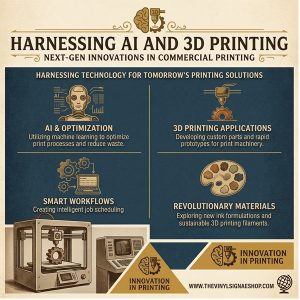
In 2026, the combination of artificial intelligence (AI) and 3D printing is changing how commercial printing is done. These technologies improve efficiency and customization while enabling more sustainable and complex manufacturing. This article looks at recent developments, practical uses, and future possibilities of AI and 3D printing in the industry.
Current trends in commercial printing
AI-driven automation and quality control
AI is increasingly used in printing processes to automate tasks like color matching, quality checks, and equipment maintenance. AI systems analyze large data sets to optimize printing settings, cut waste, and maintain consistent quality, helping lower operational costs.
3D printing for customization and rapid prototyping
3D printing has expanded from prototyping to full production runs, allowing quick customization of products and packaging. This flexibility shortens lead times and supports personalized solutions that meet changing customer needs.
Innovations at the convergence of AI and 3D printing
Smart manufacturing ecosystems
Combining AI with 3D printing is creating autonomous manufacturing systems. AI handles real-time data to optimize print jobs, monitor equipment health, and adjust to new production demands, resulting in smooth, high-quality results.
Material development and sustainability
AI models are speeding up the discovery of new printable materials, including biodegradable and recycled options. When paired with 3D printing’s low-waste approach, these advances support more sustainable manufacturing practices.
Complex geometries and multi-material printing
AI-driven algorithms make it possible to design and produce complex shapes that were once too costly or impossible. Multi-material 3D printers guided by AI can create detailed, functional objects with different material properties, opening new possibilities for packaging, branding, and functional parts.
Future outlook
Over the next decade, expect continued progress in AI and 3D printing, leading to fully automated, highly customizable, and environmentally friendly commercial printing solutions. Companies that adopt these tools will benefit from faster turnaround times, lower costs, and new product options.
Conclusion
Using AI and 3D printing is likely to reshape commercial printing in 2026 and beyond. Embracing these technologies can lead to higher efficiency, more creative options, and greater sustainability, helping companies stay competitive in an evolving industry.